Engineering the future
I love those collisions of circumstance that make the most unlikely of projects momentarily possible. Their legacy can sometimes offer long-term benefit but, all too often, any trace of their once-essential purpose is reduced to little more than a curiosity, writes Paul Hyett.
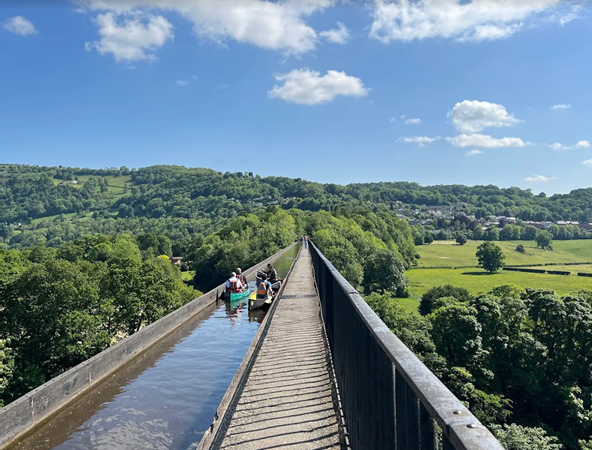
The Pontcysyllte Aqueduct is a brilliant example. This extraordinary feat of engineering would have been technically impossible to deliver a mere five years before construction started in 1795; it opened in 1805. It would have been economically impossible to finance it a mere 20 years later – and, indeed, forever thereafter.
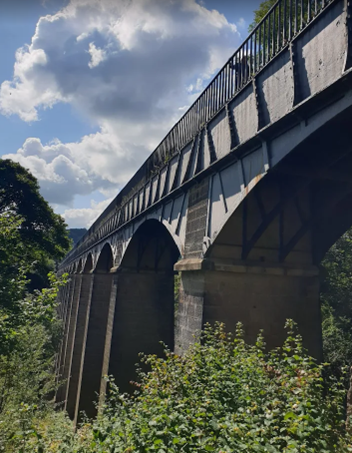
Pontcysyllte Aqueduct
It was made temporarily viable through the rapid evolution of new market forces that, together, demanded and fostered both a leap in technical progress relating to transport engineering, and in cost economies associated with freight haulage. The economics were simple: one horse could pull a one-ton load by cart on a road, 8 tons by rail, and a massive fifty tons by water. In the UK, horses had been pulling goods by rail since the early 17th century – coal was transported by horse-drawn wagons on the Wollaton Wagonway from 1603. So with one man and a horse able to shift fifty times and six times respectively the weight by water that they would by road or rail, the attractiveness of canal operation and investment was a no-brainer.
Couple that with the booming coal, slate and iron industries of North Wales, resulting from the rapid industrialisation of Britain in the late 18th and early 19th centuries, and it was game on: canals, offering a steady and reliable 4, even 6 mile per hour pace, could not be matched in terms of economy by either horse-drawn road or rail wagons. But investors and manufacturers wanted rapid returns on their money, to enable rapid re-investment in more production. So speed of canal transportation, as well as reductions in manpower costs per ton moved, became the absolute imperatives against which stronger and faster horses, the introduction of relays, better towpaths, lock optimisation and canal alignment all played a key part in honing efficiencies.
Into that special window of Welsh opportunity arrived engineers Thomas Telford and William Jessop, with their novel concept of containing canals in cast iron troughs. This was a game-changer for aqueduct design which, since the Romans, had been based on stone construction. Indeed, the Chirk Aqueduct some two miles east of the Pontcysyllte – also by Telford and Jessop and completed in 1801 –utilised stone because the designers were still developing and testing iron.
The proposed Pontcysyllte crossing, at 38 metres, was 33 per cent higher than Chirk, and 307 metres and 50 per cent longer. So the benefits of iron for the Pontcysyllte were immense. Smaller tapering stone columns supporting lightweight iron arches justified smaller foundations: these radical innovations facilitated the economic advantage of a stunning aqueduct high above the river Dee and valley floor. This, in lieu of the twenty or so locks that would have otherwise been called for, offered indisputable net advantages in terms of the combined capital, maintenance and operational costs involved: no locks offered uninterrupted passage and saved a good seven to 10 hours journey time each way.
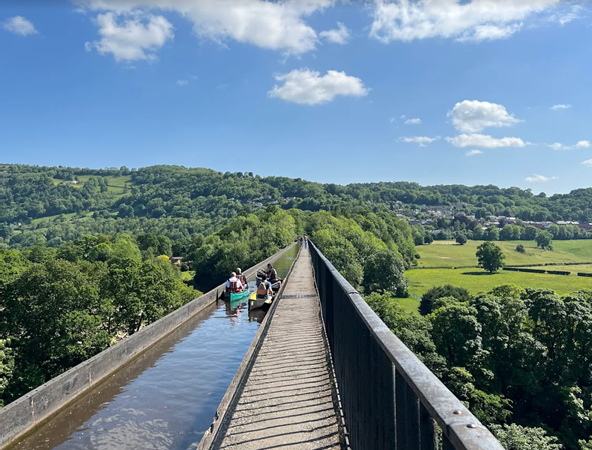
An alternative to traditional locks
All this paved the way for Wales becoming the world’s first industrial society: from 1851, more people were employed in industry than in agriculture.
However, the feasibility of canal construction and operation would become increasingly marginal from 1812, with the opening of the Middleton Railway which used steam locomotives to haul coal, and more so in 1825 with the opening of the Stockton and Darlington railway line. The heyday of canal construction, between the 1770s and the 1830s, had seen the navigable system grow from 1,400 to some 4,000 miles. But by the 1840s, rail freight’s annual tonnage would surpass that of the canal system, the decade marking the beginning of its end.
Just a few years after canal economics had financed the world’s longest and highest freight-carrying aqueduct, the financial viability of even maintaining canals would be in freefall.
While the state of industrialisation was not so advanced elsewhere in the UK, the sheer scale of urbanisation had been producing major problems of public health, particularly in the likes of Manchester, Liverpool and of course, London. Here again economic challenges emerged that would demand much of engineers, especially in the areas of public health infrastructure. With cholera a major killer – the 1858 outbreak in London being particularly notable – demands rapidly intensified for safe drainage and sewage treatment. Cometh the hour, cometh Joseph Bazalgette who, between 1858 and 1875, would perform a leading role in the delivery of some 1,100 miles of sewers which effectively served the whole of London. Engineering thus played a critical role in facilitating the relentless onward growth of the world’s largest city, which London had become in 1831, and would remain until 1925.
By the late 19th and early 20th century, the onward rapid industrial and suburban growth of the capital, particularly in its eastern quarters around the shipping and dock areas, had generated new and increasing pressures in transport infrastructure: enter engineer Alexander Binnie.
Initially building on Bazalgette’s work on water supply and sanitation, particularly in the areas of reservoirs and sewerage treatment plants, the firm he created in his own name is, even today, renowned for its water specialist services across Europe and Asia. But in parallel, Binnie developed particular interests in bridges and tunnelling and so it would be this, as with the Pontcysyllte Aqueduct, which addressed a collision of economic forces and the opportunities afforded to innovative engineering practices which would facilitate unique solutions. Those forces are neatly captured within the delightful diagram produced courtesy of AI and never before seen publicly, as shown below:
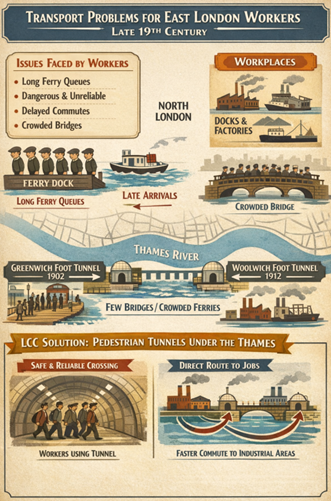
Dedicated AI transportation mapping diagram.
In short, while the factories, docks and commercial centres of London had, for obvious reasons, been concentrated along the sides of the Thames, the workers who serviced those businesses often lived on the opposite bank to their respective places of work. Most of London’s bridges were in the central and west parts of the fast-growing metropolis, that is upstream of the City of London, so river crossing was, for the east-end workers, an eternal and all too often desperate challenge.
Service demands fell most heavily on costly ferries which were slow, unreliable, prone to disruption in bad weather, and anyway inadequate to meet the scale of need. Against this growing challenge, the factory and dock owners were cruelly unsympathetic to their workers’ plight: with an oversupply of labour they were content to impose severe conditions – piece-work was endemic, fines imposed for late arrival punitive, and workers, having walked miles upstream to cross by bridge when ferries were unavailable, were all too often subjected to the indignity of waiting ‘at the gates’ in the hope of half a day’s work.
All of which came to a head with the 1889 London Dock Strike, during the prolonged course of which the protesters were assisted in staving off their families’ starvation by the ongoing efforts of the Salvation Army and, mercifully, a £30,000 cheque that arrived out of the blue from trade unionists in Australia. Thankfully, albeit only after months of misery and hardship, the dispute was ultimately mediated to a settlement by the redoubtable Roman Catholic Archbishop of Westminster, Cardinal Manning.
Out of all that came a generation of leaders, drawn from the ranks of workers, who would go on to have distinguished political careers within the London County Council (LCC), newly formed in 1889, and within national government. This is key: the role of working-class people in the promotion and realisation of London’s public utilities and infrastructure cannot be overstated.
Among these was Will Crooks who began life within an impoverished family in Poplar – his father, a ship stoker, had lost an arm in an industrial accident and the family ended up, albeit only temporarily, in a workhouse courtesy of the New Poor Law of 1834. Will, who neither forgot the experience nor forgave the circumstances that led to it, went on to work as a cooper. There, alongside the likes of John Burns, Tom Mann, Ben Tillett, Will Thorne and Eleonor Marx (yes, the great man’s daughter!), Crooks became a keen union representative and a Fabian. Later, this self-educated man would find himself elected to the LCC and, ultimately, to Parliament as MP for Woolwich.
Meanwhile, a tireless advocate for Alexander Binnie’s work, Crooks was appointed to the LCC Bridges Committee which oversaw the work of the engineer’s Blackwall Tunnel, opened in 1897, and the Greenwich foot-tunnel (which Crooks had championed) opened in 1902. These were later complemented by the less well known Woolwich foot-tunnel designed by Sir Maurice Fitzmaurice.
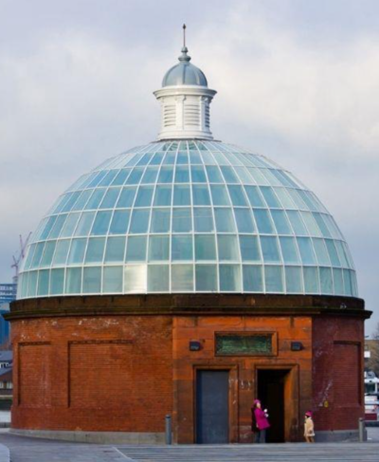
Greenwich foot tunnel entrance – south side
Crooks’ advocacy of these rather simple foot-tunnel projects was typical of the man: he never lost sight of the importance of providing practical assistance for his fellow workers in all aspects of their everyday lives, including their struggles of travelling to and from their place of work. 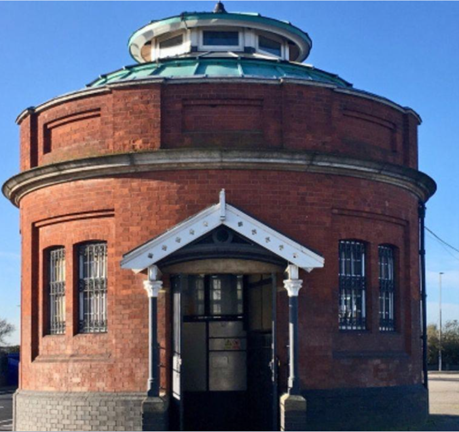
Woolwich foot tunnel entrance – north side
That simple commitment to improving social infrastructure, especially for the poorer members of the community, and manufacturing efficiencies, remained a driving force across decades of London County Council projects, most notably under the later leadership of Herbert Morrison who, as a Labour Councillor, championed the growth of public housing, services, and education in his efforts to make the LCC a ‘paragon of responsible active government’.
Just feet above Binnie’s Blackwall Tunnel now sits the Millenium Dome. Seen at the time of opening as little more than a vanity project, it would become a defining symbol of Tony Blair’s New Labour – a stark contrast to the robustly utilitarian structure that it straddles. Sadly, along the way, and against the examples of the likes of Will Crooks and Herbert Morrison, too many of our political leaders have gone astray, wedding themselves more to spin than substance. Arguably in this respect, none more so than Morrison’s grandson, Peter Mandelson, under whose ministerial leadership the Dome was delivered.
Unlike the now-disgraced Mandelson, neither Crooks nor Morrison ever lost their sense of public service. Indeed, when his old manager, who had first taken him on as a cooper making beer barrels, offered him a place on the Board with prospects of a partnership, shares in the brewery, and a substantial pay increase over the Poplar Labour League’s wages fund that sponsored his political activity, Crooks declined. He allegedly said:
‘That is indeed a great opportunity, but I gave up the workshop for a life in public service because I want to serve the people . . . so, although I am honoured to receive such an offer from you, I must decline’.
All this matters because socially purposed architecture and engineering ultimately both depend on the economic and political probity and rectitude under which they are delivered. In this respect, and as an eternal optimist, I am hopeful that after several decades which saw the Conservatives’ obsession with de-regulation, and what some critics say was New Labour’s substitution of spin for integrity, we could, just possibly, be in for a ‘back to basics’ new start.
I for one would welcome that.
Founder Partner