Cultural growth in desert contexts
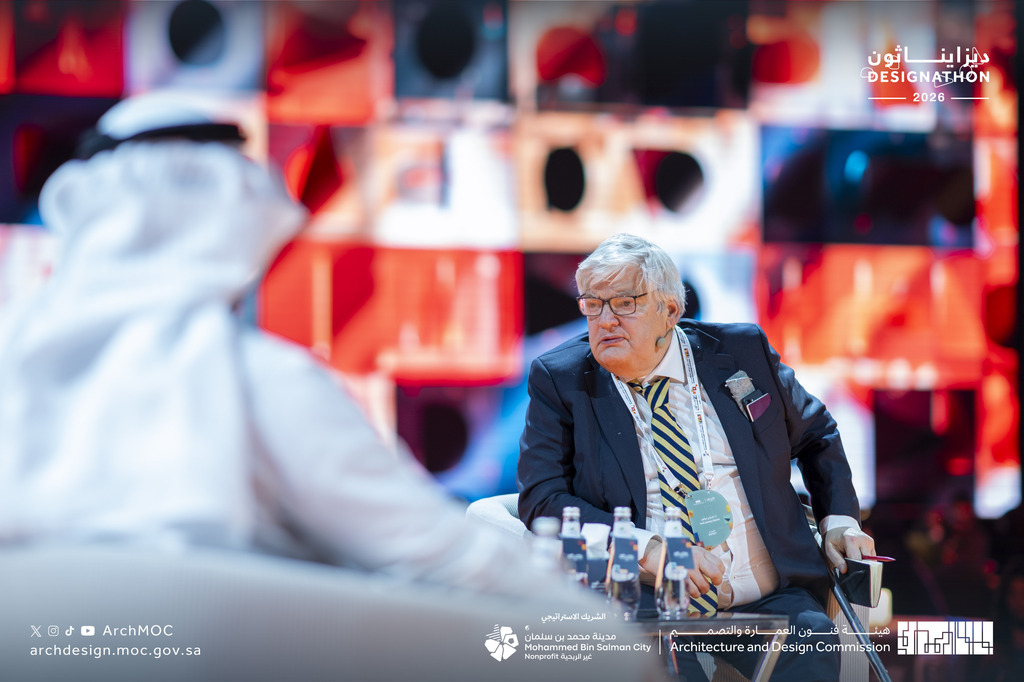
Picture: WAF curator Jeremy Melvin chairing the discussion panel at the start of the Designathon. Mohammed Alkhabbaz back to camera.
Saudi Arabia has an infectious fascination – at least that was my response after spending a few days there to take part in ‘Designathon 2026’ in Riyadh, writes Jeremy Melvin.
The event was open to ‘individuals passionate about crafting creative solutions across diverse fields and specialities’. Of 2000 applicants, 500 were picked to take part, forming groups of three to five people with at least one experienced in design. Organised by the Saudi government’s Architecture & Design Commission, it is part of a linked series of initiatives aimed at the making the country a design powerhouse, providing the intellectual and creative software to underpin its Vision for 2030, which it is implementing in part through vast construction projects.
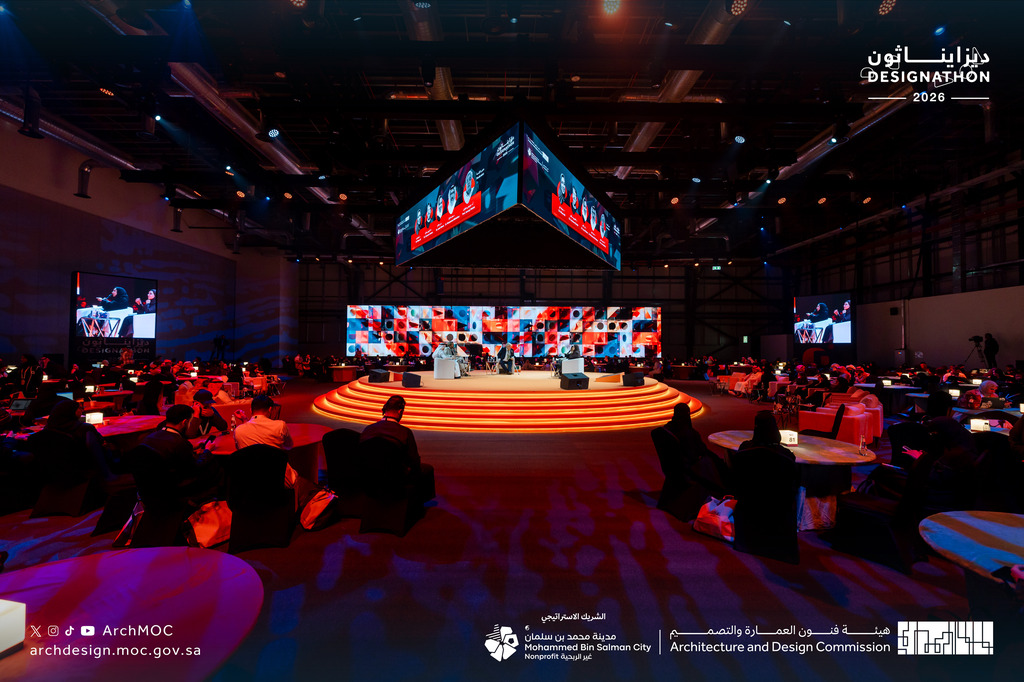
The stage for the discussion was 'in the round'.
By then, Riyadh will be a city of 11 million people, one of the largest conurbations this side of East Asia. A century earlier it was about to become the capital of the new country Saudi Arabia (established in 1932), created by Ibn Saud amid the collapse of the Ottoman Empire, nominal overlords of the Arabian peninsula. This involved a combination of grit, diplomacy and military action from roots in Wahabist Islam and the long-evolved culture of living in such a harsh land, all being forged into a form of legitimacy. In 1930 Riyadh, long a powe rbase of the Saud clan and more or less in the middle of the country, was essentially a settlement of mud brick architecture, of which the district of Diriyah on the city’s edge is a rare survivor. Now a UNESCO World Heritage site, it is being promoted as a tourist venue. Commercially viable oil deposits were discovered by the end of the 1930s, and the rest is history, albeit a complicated and circuitous one.
It is now a functioning modern city, with interesting museums; a newly minted metro is superb, efficient, comfortable and easy to navigate (with signs and announcements in English as well as Arabic). Although one may baulk at the means by which it got there and bemoan the quality of much of its architecture, this is what the 2030 Vision and the Architecture & Design Commission are trying to change. One part of the vision is Mohammed Bin Salman City (Misk), touted as the world’s first non-profit city. Covering about 350ha, it will have academic institutions, a conference centre, a science museum, facilities for creatives and residential areas, and although far from finished it also hosted the Designathon from 29-31 January.
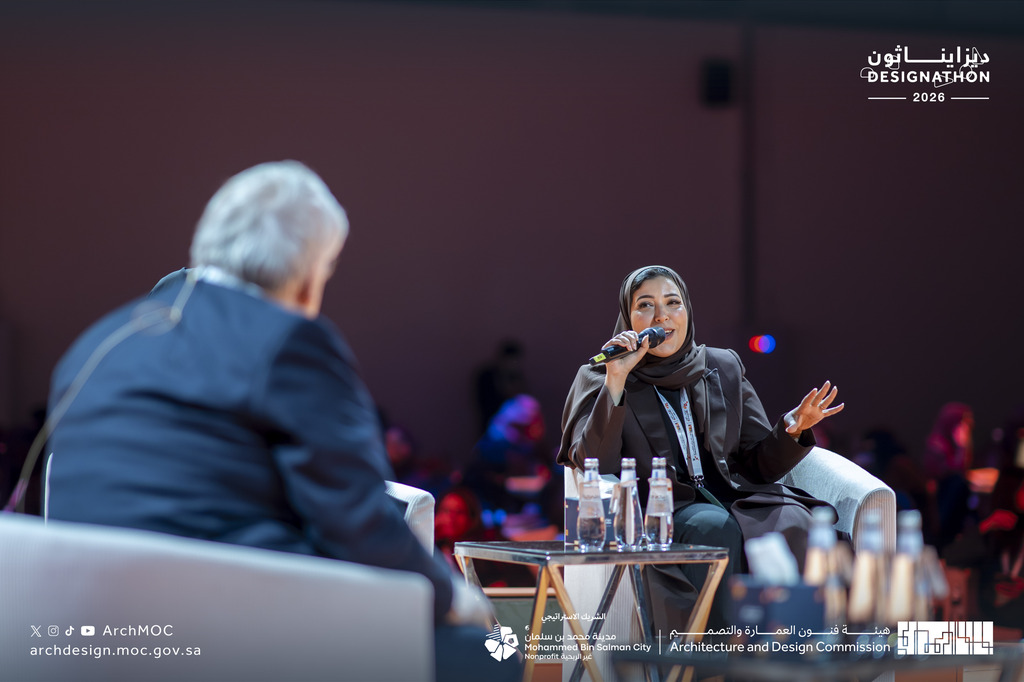
Panellist Miram Ali responds to a question from Jeremy Melvin.
Teams taking part in the event were allocated one of three themes, ‘Design for place’, ‘Design for everyone’ and ‘Design and technology’. After registration it kicked off with a panel discussion (chaired by your correspondent) with a speaker for each theme – Miram Ali on Design and Technology, Cameron Sinclair on Design for All, Mohammed Alkhabbaz on Design for Place, with Lama Hakem on Design Thinking. Despite the various perspectives, the role of empathy in understanding how design can serve people emerged as an underlying theme.
Each team had to find and agree an idea to pursue, and then with the help of mentors to develop it over three days. The results were assessed by a team of judges, with ten teams from each stream asked to do quick-fire presentations, with each stream having a first, second and third-placed team. It was almost as if WAF combined with the design charettes at the Ecole des Beaux Arts which decided who would win the Rome Scholarship (and subsequent lucrative career) for that year; like their Beaux Arts predecessors, some of the participants had very little sleep.
The energy was astounding. Many of the participants were young and all seemed eager. One group to whom I spoke proposed a way of planting, watering and maintaining trees in the hot, dry Riyadh climate, to provide both shade and the possibility of public spaces for informal gatherings (of which there are few in the city at present). One of the most animated members of the group was the youngest: a female student in a burqa (now longer mandatory in public, but still worn by many women), whose dynamic body language made up in expressiveness what one couldn’t see in her face. This did not seem to be a generation (or sex) who feel that repression negates their life changes.
On the contrary, a palpable air of optimism pervades the atmosphere. Of the nine prize-winning teams, four were all-women, and only one all-men: the rest were mixed. After two days of work and judging, the event concluded with an awards ceremony, granted by Prince Nawaf bin Abdulaziz bin Ayyaf, the urbane, Harvard-educated CEO of the Architecture & Design Commission, which had added spectacle from stage pyrotechnics.
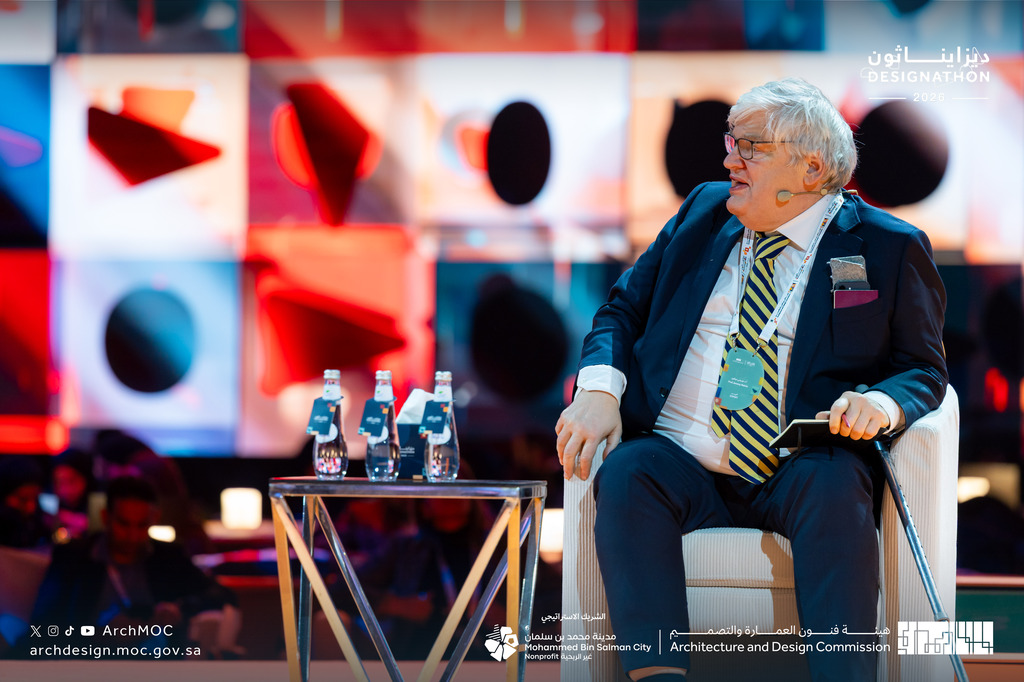
Panel chair Melvin.
Overall Riyadh was a pleasant surprise. Admittedly I was seeing only a small part of it and was very well looked after by my hosts, but – traffic aside – the city worked well. One day I made my way to the National Museum, designed by Japanese-Canadian architect Raymond Moriyama, opened in 1999. It tells the (no doubt officially approved) history of Arabia from geological times to the emergence of the modern state. It is gripping, especially when it moves into the Anthropocene era. In the harsh, arid peninsula, parts of which resemble moonscapes, any feature with any potential to contribute to supported human life has to be exploited, whether it is deposits of sparse rainwater (there are no rivers to speak of), pasture for grazing or food.
The contrasting waters of the Red Sea to the west and the Persian Gulf to the east – one deep, warm and very saline, the other shallow and less salty –have been since time immemorial and remain vital trade routes, so the first cultures to emerge were based on trade. Some were local but others, boosted by the sea, reached distant destinations. Local produce included metal ores, spices like frankincense and myrrh (some of which came, like coffee slightly later, from across the Red Sea in what is now Somalia and Ethiopia), and pearls from the Persian Gulf, relatively plentiful and easy to harvest in the shallow water. Alongside trade, the region became spiritually significant. Mecca is of course the primary holy site in Islam, but there are legends that connect the Biblical patriarch Abraham to it too.
These civilisations had two basic attributes: inventive in finding ways to survive in the climate, and becoming adept at trade, two qualities which run through the region’s subsequent history. If pearls were an early example of high value produce (with widespread trading potential), that role is now filled by oil. Over time small polities, kingdoms, sheikdoms and city states rose and fell with bewildering regularity. Many if not all left some trace, in practice and convention if not artefacts. Though those artefacts which survive can be remarkable with dramatic ruins of abandoned cities.
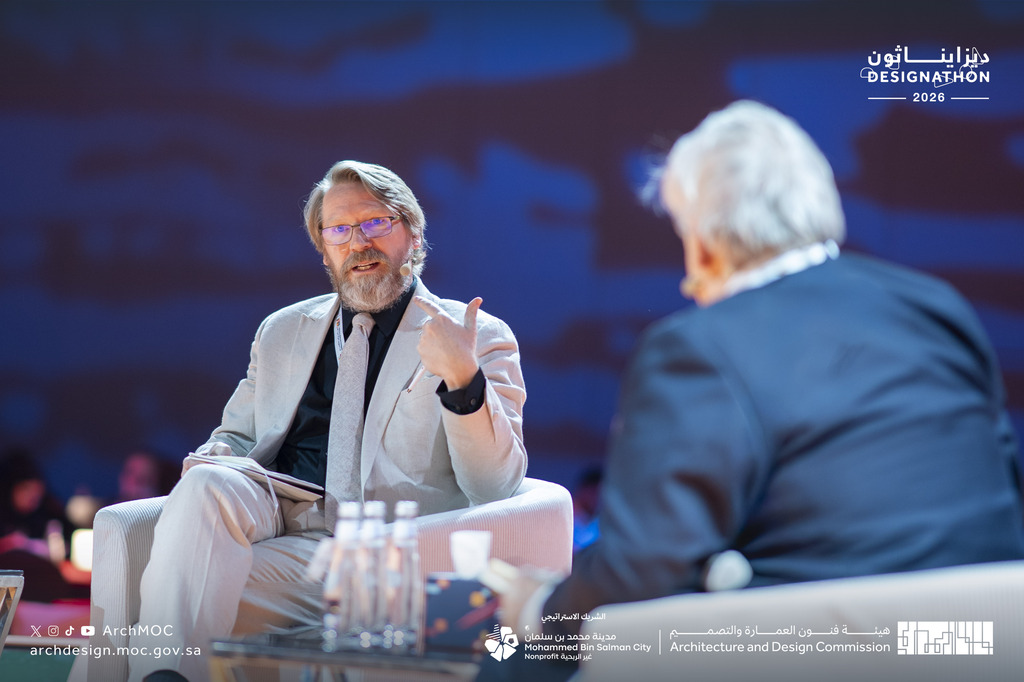
Cameron Sinclair makes a point.
It is perhaps this evidence of human occupation of Arabia that underpins the role of architecture in their culture and society. Buildings – whether tents or stone vaults – are essential to supporting life and can make the climate more or less inhabitable. (I remember Rod MacDonald, one of the ‘originals’ who left Arup with Ted Happold in the 1970s, telling me that Ted had encouraged him, when working on the firm’s early commissions in Saudi, to explore whether the buildings could be made habitable even if air conditioning failed: ‘We almost got there’, Rod concluded). And buildings have the potential to become memorable and effective symbols of culture, identity and belief.
These thoughts raised another idea: that much of Saudi Arabia’s enormous and well-resourced construction and social initiatives tend towards conveying a notion of legitimacy, this despite the well-publicised abandonment of Neom/Line megastructure elements. The urge behind them had roots in the huge and largely abandoned cities of the desert (Shelley’s ‘vast and trunkless legs of stone’ which ‘stand in the desert . . . nothing beside remains. Round the decay of that colossal wreck, boundless and bare, the lone and level sands stretch far away’). If boosted by oil wealth, the country cannot just break its dependency and status on oil, but also transform at least parts of the desert into long-lasting, permanent centres of human culture and creativity as well as merely life, that will be a considerable achievement.
Founder Partner