A beautiful living thing: rebuilding the Mack at the Glasgow School of Art
In 2015, at the Building on Mackintosh symposium hosted by the Glasgow School of Art, delegates watched A Beautiful Living Thing, a short film by Ross Birrell, writes Rory Olcayto. Panning shots of the school’s charred masterpiece, ‘the Mack’, moved slowly across the screen to a solo violin score – a downbeat lament capturing the civic grief felt nearly a year after the disaster. It laid bare the wounds of an architectural icon whose world-famous library had been incinerated in the conflagration, silent and scarred on the steep slopes of Garnethill.
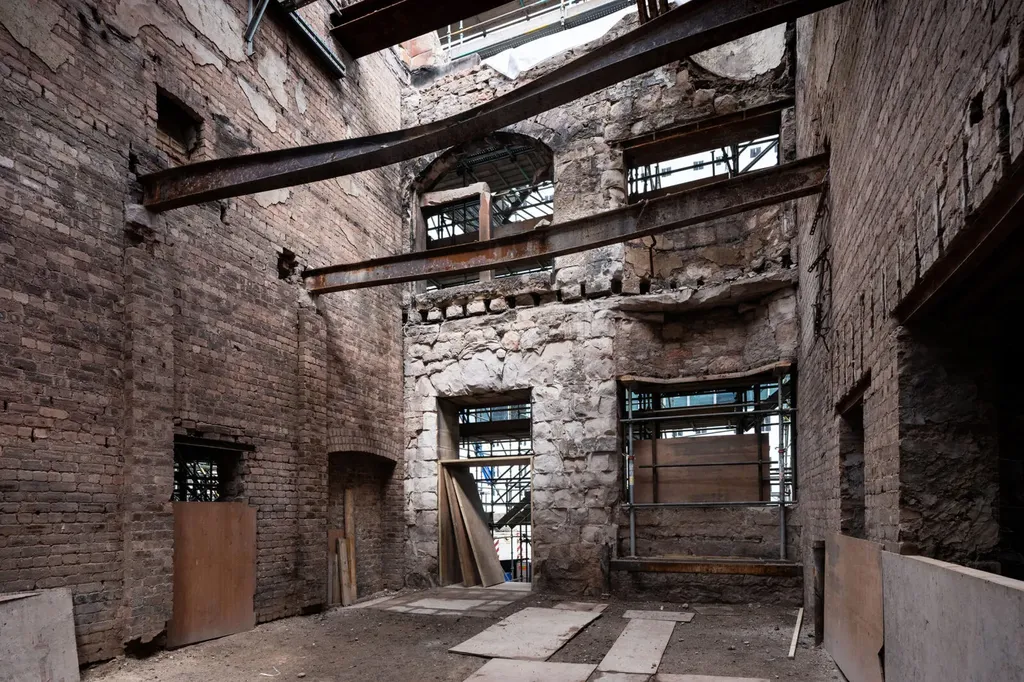
More than a decade has passed; that moment of fragile optimism has vanished. A fractious mood holds sway. No wonder. After a second, catastrophic fire in 2018 all but erased the entire school – including its nascent, rebuilt library – only the magnificent stone facades endure, holding nothing inside but empty space. Eight years on from that second fire, the Glasgow School of Art has admitted that a faithful reconstruction is beyond its solitary grasp, calling upon the wider world to help it rise again in some yet-unknown guise. Though details remain scarce, trusted voices whisper that the newly settled insurance payout falls far short of the projected £265 million required. The contrast with 2015, when Page\Park stood ready to heal the building and Birrell’s lament offered hope of rebirth, could not be sharper.
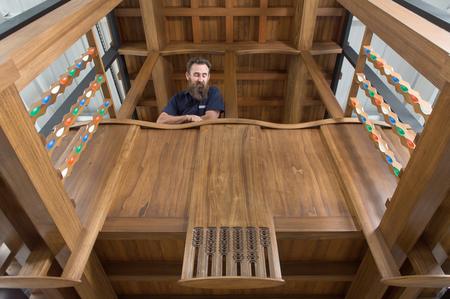
Rebuilt library bay © GSOA
Yet beyond the institutional gridlock of the GSA, a chorus of outside voices has begun to orchestrate a rescue. Spearheaded by the Rebuild the Mack campaign, momentum is surging to take the shattered masterpiece out of the hands of a school whose stewardship is widely viewed as exhausted. While they have held back from asking the school to step aside, both the Victorian Society and the National Trust for Scotland, which is leading a successful ‘rescue’ of Mackintosh’s rain-soaked HiIl House, have called on the Scottish Government to fund a full reinstatement. The Charles Rennie Mackintosh Society has gone further, demanding a new model of custodianship. Under the leadership of its new director Matthew Williams, it proposes an independent, expert-led restoration trust – a special purpose vehicle capable of bypassing the school’s financial paralysis to deliver a faithful reconstruction, echoing my own call to rebuild without the art school.

The fire © Scottish Fire and Rescue Service
This grassroots rebellion has forced a reaction from Holyrood, with Scottish Culture Secretary Mairi McAllan making positive noises, and promising the government’s ‘full support’ to convene a coalition of cross-border funding partners. But while the government's sudden involvement injects a welcome rush of political adrenaline, its reliance on the pragmatic phrase to ‘work out the art of the possible’ carries a sharp note of caution; in a city that has already seen the Mack incinerated twice, any compromise that trades a full, authentic reinstatement for a watered-down pastiche of "Mackintosh best bits" would be a profound cultural surrender.
To understand why a partial reinstatement – or any compromised ‘art of the possible’ –would be a profound failure of nerve, you have to return to Ross Birrell’s film, and to the mind of the man who designed the school. The title ‘A Beautiful Living Thing’ is drawn from ‘Seemliness’, a lecture delivered by a young Mackintosh in Glasgow in 1902. At a high point in his career, he outlined a design philosophy that read like a manifesto: ‘Let every artist strive to make his flower a beautiful living thing,’ he declared, ‘something that will convince the world that there may be, there are, things more precious, more beautiful - more lasting than life itself.’
He achieved it, too. Writing after the GSA’s sorry declaration to minimise its rebuild plans, I argued that Mackintosh had created something that transcended mere building, architecture, or urban design, and belongs in a pantheon of Scottish cultural artefacts alongside the Book of Kells and the Lewis Chessmen. To reduce it now to a preserved stone facade wrapping a newbuild core would be a shameful act of corporate taxidermy.
Mackintosh’s devotion to a total synthesis was so deep he even built it into spaces no human eye was ever meant to see. I was standing in the ruined library with David Page of Page\Park during that 2015 symposium when he brushed a hand across the exposed brickwork of the library’s east wall. The fire had stripped away the heavy timber panelling, exposing three angled courses of brick cutting across the horizontal lines – a distinct, hidden motif shaping the stem of a plant reaching upward for light.
‘Could it be a plant, a flower, reaching upwards, always growing, moving up through the building?’ Page asks. ‘You can think of this building as built vegetation, a built plant, a built flower . . . Finding an expression for that here, in this brickwork is the kind of thing Mackintosh might do.’ It made complete sense. Steeped in the organic symbolism and magical polemics of the 1890s, it has been argued he was an occult practitioner. Mackintosh was always subverting standard materials, coaxing industrial brick and steel into something vital.
That is what is at stake, and what decision-makers in Holyrood and Glasgow need to understand. Mackintosh led a difficult life and died too young, long before the world fully realised the depth of his artistry. Watching his masterwork slowly disintegrate through bureaucratic exhaustion feels especially cruel.
If the Scottish Government is content to limit its vision to the ‘art of the possible,’ then it falls to the rest of us to push for the art of the impossible. Rebuilding the Mack in full won't be easy, cheap, or quick. But anything less surrenders the very thing Mackintosh set out to create: not just a functional shell, but a beautiful living thing.
Rory Olcayto is a former editor of The Architects’ Journal. He will chair the WAFX award presentations and discussions at the Festival in Fort Lauderdale this November.
Founder Partner