The construction site: culture, safety and convenience
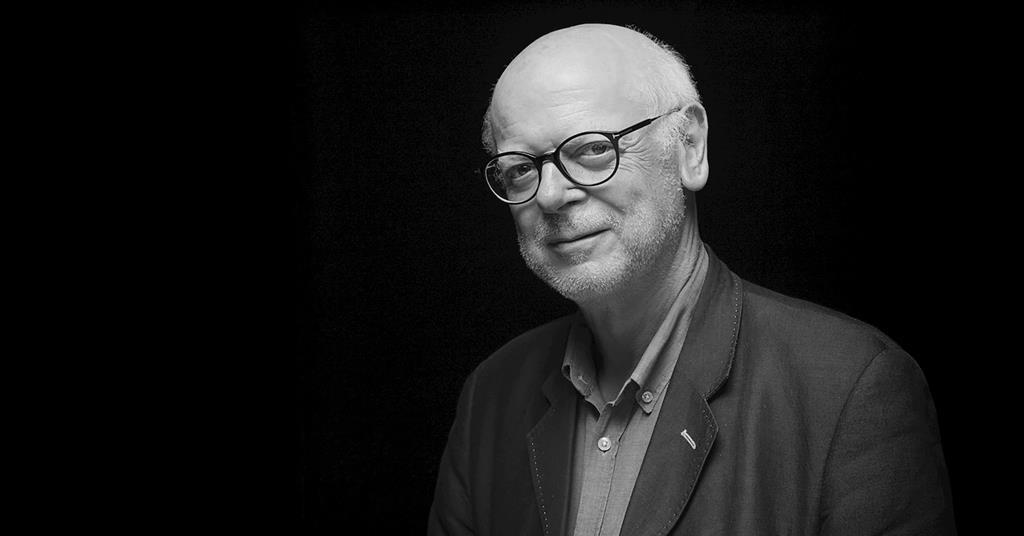
Beneath a ‘girlie’ calendar in the site hut sat a newly appointed structural engineer, the only woman among twelve men. Hitherto insufficiently sensitive to the offensiveness of such calendars in workplace settings, I was ashamed, writes Paul Hyett.
After the meeting I asked the site agent to remove the calendar but he refused, offering instead to cover it during future site meetings. The year was 1992.
A full-blooded confrontation arose. I directed the agent to remove the calendar and advised that from then on, no such calendars or pictures would be tolerated anywhere on site, including in the canteen, locker rooms and welfare facilities.
My action was highly controversial at the time: it would be another 23 years before The Sun abandoned its Page 3 topless model photos, despite the newspaper having had a female editor between 2003 and 2009.
As a major point of principle, the site agent insisted I had no authority in the matter and adamantly refused to comply with my order. Deadlock having been reached, the company’s managing director became involved: ‘Boys will be boys, this isn’t really important’ etc.
Unyielding, I threatened to use my power under the contract to instruct, with immediate effect, the removal and replacement of the man who happened to be his best site agent. The calendar came down.
Since then, our industry’s culture has changed so dramatically that even a Pirelli calendar would be deemed unacceptable.
Behavioural norms within the construction industry have changed significantly over the last four decades, as indeed they have across most industries and sectors. Those changes have run much deeper than the inappropriate portrayal of women in calendars: male workers in particular, irrespective of rank or seniority, have had to adapt to very different expectations of workplace behaviour.
But, as we well know, the issues run far deeper than lewd pictures or risqué conversations. Historically, many operational professions, including construction, engineering, policing and the fire service, developed strongly male-oriented cultures.
Similar debates have thus unfolded across many traditionally male sectors. The London Fire Brigade was criticised during the Grenfell Tower Inquiry for displaying elements of a culture regarded as overly macho, including training materials that relied upon outdated gender stereotypes. This genre of criticism would have been almost unimaginable when I first entered the workplace. Thankfully, such imagery has at last been phased out, and contemporary fire-brigade recruitment material now explicitly avoids the traditional, trope-heavy ‘damsel in distress’ motif. The intent here is, of course, to effectively deconstruct gender stereotypes and encourage women to join the operational workforce.

Image used during Victorian-era recruitment of the London fire brigade.
Fortunately, attitudes have evolved rapidly. Organisations increasingly recognise that both representation and workplace culture matter. The objective is not merely fairness, but also talent: industries that exclude half the population simply cannot recruit the people they need.
Likewise, the construction industry had long been infused with a male-dominant culture, hence my calendar story. Happily, the last few decades have seen a major increase in the proportion of women in the industry. Within architecture, when I started training, there were just four women, or ‘girls’ as we would have casually described them at the time, in a class of 37. A mere 20 years or so later, student ratios had reached 50/50.
The transformation has been striking. Today, women slightly outnumber men in UK architectural education, although the profession itself remains predominantly male and the wider construction workforce remains approximately 85 per cent male. The greatest imbalance is still found on site, where women account for only a tiny proportion of skilled trades. However, apprenticeship numbers are rising steadily, while labour shortages are forcing employers to widen recruitment. The direction of travel is unmistakable.
Technology may prove an even greater driver of change than culture. As more construction activity moves from muddy sites to controlled manufacturing environments, many of the traditional barriers that discouraged women from site-based careers are disappearing. At the same time, drones, robotic setting-out equipment, digital twins and advanced off-site manufacturing are transforming the nature of construction work itself. The industry's future workforce will be recruited increasingly for technical competence rather than physical strength.
Demographics are reinforcing this transition. Faced with acute labour shortages and ambitious housing and infrastructure targets, the industry can no longer afford to draw from only part of the available talent pool. Recruiting more women is not merely desirable: it has become an economic necessity.
Increasing female participation is already driving improvements in welfare provisions and safety equipment. Yet attracting new entrants is only half the challenge. Retaining them will require construction sites, facilities and working practices to evolve in ways that many would have scarcely imagined possible when I started my career. These changes include the redesign of personal protective equipment (PPE). For decades most standard PPE was developed around male body shapes. Manufacturers now routinely produce female-fitted equipment as standard.
Site facilities are changing too. Regulations and client requirements increasingly demand clean, secure and separate changing and hygiene facilities for women on major construction projects.
The idea that site design influences workforce wellbeing is not new. Interestingly, some of the thinking now associated with inclusivity, welfare and workforce retention was anticipated more than 50 years ago by my old boss, Cedric Price.
In 1972 Price was well ahead of the game in responding to anticipated health, safety and environmental legislation applicable to building sites, including the 1974 Health and Safety at Work Act, and Control of Pollution Act. Commendably, he had persuaded Alistair McAlpine (later Lord McAlpine) to commission a comprehensive review of all McAlpine construction site activities. The ‘McAppy’ project, upon which I worked as an assistant for three years, was allocated a live site near the Bank of England. There we conducted research and trialled new operational concepts.
We designed suites of office furniture, modular site offices, changing rooms (that included showers), canteens and kitchens. There were site material storage facilities, provisions for noise control, and security arrangements. Here are a few images, as selected from Cedric’s final report, which give a clear indication of the ambition, the richness and the diversity of the programme.
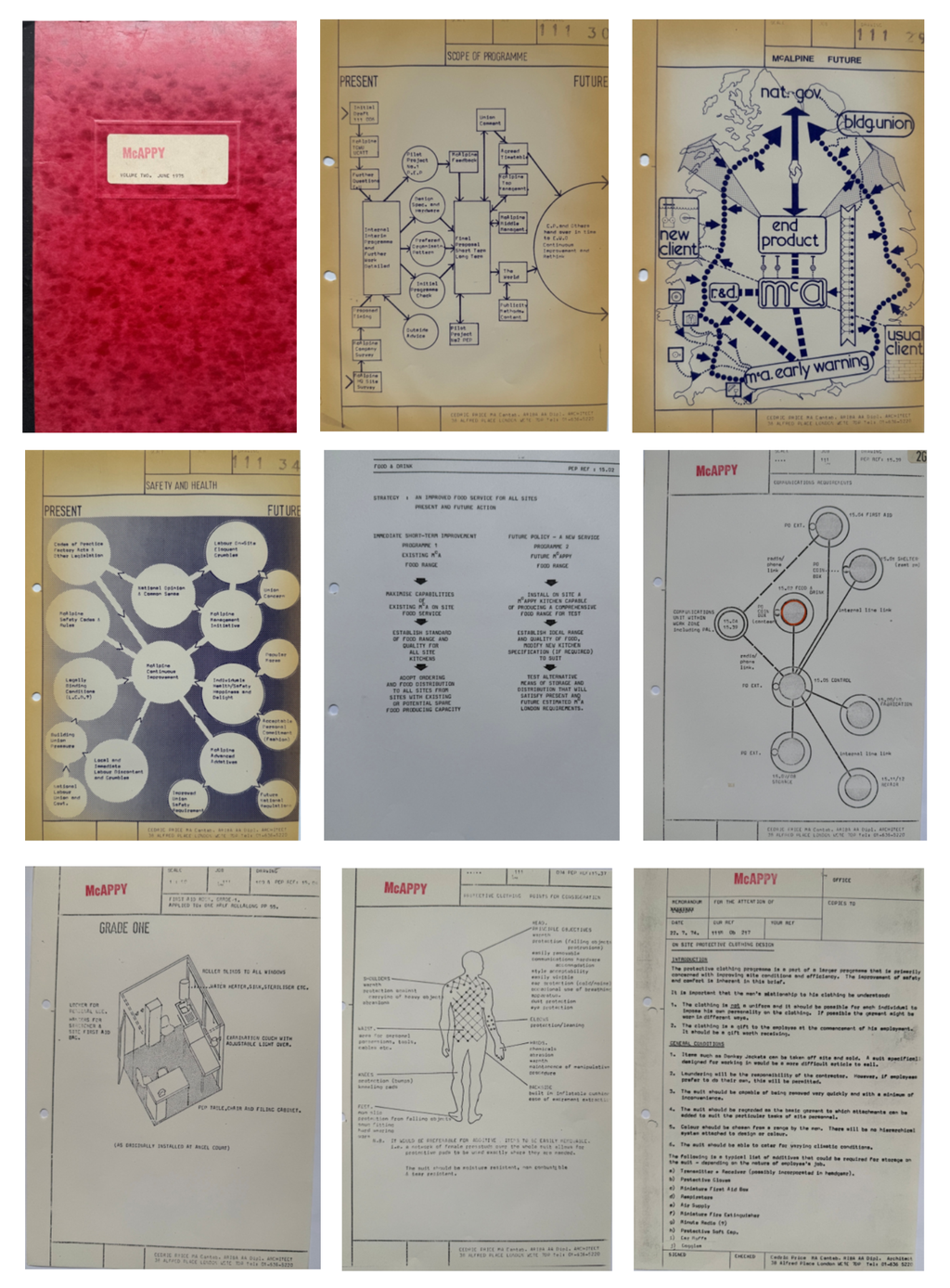
Extracts from the Cedric Price ‘McAppy’ report.
Professor Arnold Bender of Queen Elizabeth College was called in to design menus appropriate to the stage of work and time of year. Moving away from quick-burning, sugary snacks in favour of complex carbohydrates and fats to sustain energy across intense, eight-hour shifts of physical labour, Bender focused on sustained macronutrient delivery, high protein retention and thermal regulation. Through this work, Bender and Price effectively reframed site catering as a critical piece of safety equipment, arguing that a worker’s calorific and vitamin intake was believed to influence alertness, productivity and potentially the incidence of workplace accidents.
Will Alsop, with whom I worked, designed a splendid range of workers’ clothing as required to meet the needs of a wide range of trades. These included padded and insulated trousers to protect against haemorrhoids when seated on cold concrete! Sadly, Cedric’s work made no special provision for women workers, either in anticipation of their arrival or as an encouragement to recruit them. That would have been another study . . .
As a child I well remember the stereotypical building worker, stripped to the waist in summer, cat-calling women as they walked past construction sites. Such behaviour would today result in disciplinary action on any properly managed project, and rightly so. Yet the most significant changes still lie ahead. The next transformation will not be about removing offensive calendars or curbing inappropriate behaviour. It will involve redesigning the construction site itself, its facilities, equipment and working practices, so that they properly serve a workforce far more diverse than the one for which they were originally conceived.
Thirty-four years ago, I found myself arguing over the removal of a calendar. Important as that issue was, that battle now seems almost quaint. The challenge for the next generation is something far more ambitious: ensuring that everyone with the talent to contribute feels that construction is an industry in which they genuinely belong. The calendar came down. The site must now change.
Founder Partner