Innovation now dwarfed in scale but not in content
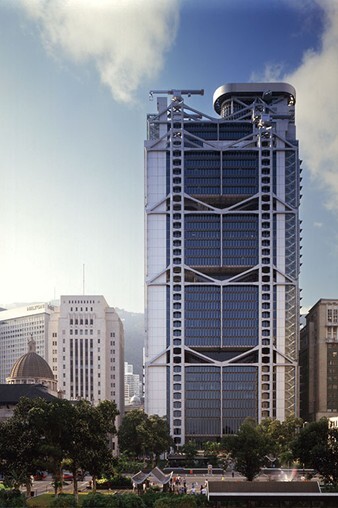
Image: 40 years since the opening of the Hong Kong Shanghai Bank in Hong Kong.
The 1980's was a time of international optimism. Until this time few architects worked beyond their own territory.
Overseas communication was becoming easier - the fax machine began to link the world sending
drawings and letters globally in minutes, where couriers would take days.
It was a time when architects around the world were entering and winning international competitions. Increasingly businesses, big and small were considering architecture as branding. In 1979 Norman Foster and Foster Associates won the competition for a new headquarters for the Hong Kong Shanghai Bank.
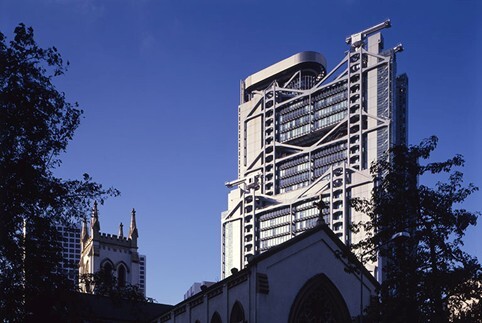
St John's Cathedral, the oldest surviving Western ecclesiastical building in Hong Kong, a few minutes walk away from the Bank, and at this time little to obscure the building.
This was Foster's first major project outside the UK and a landmark of high tech architecture. This 44 storey tower was a seminal project for the firm, transforming them from UK focused into a global company. Hong Kong did not have the fabrication skills or the technology to build to Fosters design and many components were prefabricated and manufactured in the UK, US and Japan. Then shipped to and assembled in Hong Kong, a process considered radical at the time. The entire construction - high tech with bamboo scaffolding, was rigorously documented by Ian Lambot an architect and photographer working in the Foster Hong Kong office.
I suspect it is difficult today to appreciate the anticipation for seeing the completion of this building. There was an excitement that permeated the architectural fraternity world wide.This building incorporated so many progressive ideas.
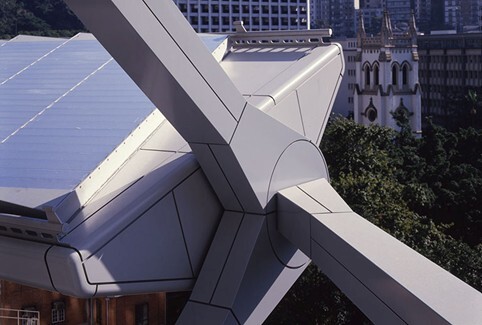
The mirrored 'sunscoop' reflects sunlight down through the atrium to the floor of the public plaza. Saint John's tower beyond.
At the end of 1985 Richard and I had been sent to Australia by Conde Nast to photograph Nindooinbah, in Beaudesert Queensland. Now a Heritage Homestead, privately owned at the time. Other projects while there for The Architectural Review and Belle Australia and included a Murcutt House, a restaurant and a garden.
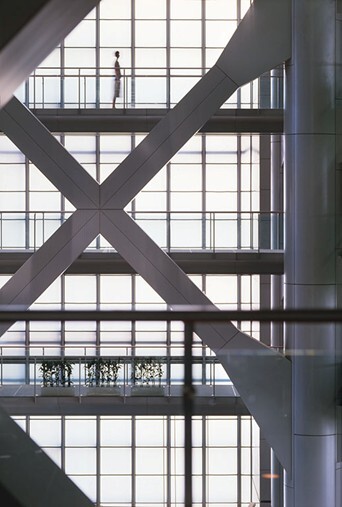
Me as a Giacometti on a bridge in the atrium giving scale.
Feng Shui advice was given throughout the design process but the X shape can have mixed messages. Here it was allegedly intended
to represent the energy of a building, but for those who interpreted it as a negative crossroads indoor plants were added by HSBC as mitigation.
Hong Kong was the obvious stopover for our return to the UK. It was mid November 1985 the building was finished and some staff and equipment were beginning to move in. This limited our time and access, non the less it was truly exciting to be there and experience it's huge ten-storey atrium, considered radical at the time. This space was made possible because the mast structure allowed for the service cores to be located at the perimeter. Connectivity between floors is mostly by escalator, 62 in all.The most of any building at that time. Escalators were considered more efficient than standing waiting in lift lobbies and less isolating than being in an enclosed box.
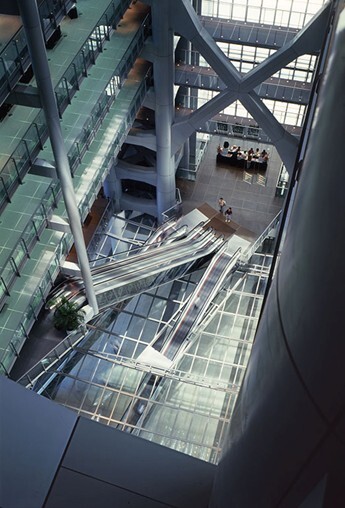
The ten-storey atrium down towards the glass floor the canopy above the pedestrian route
The glass underbelly creates a canopy for pedestrians crossing the public plaza and offers a glimpse of the buzz of activity below for the buildings inhabitants. By providing this public space the H.K. Building Department allowed the building to increase it's footprint by 17%.
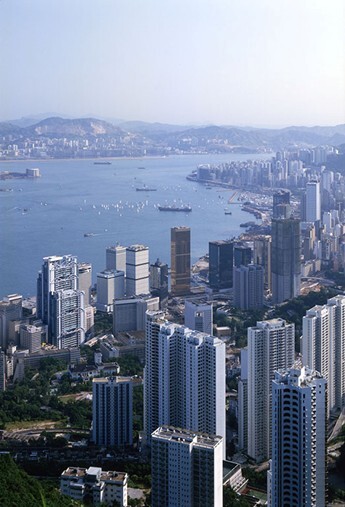
Unlike this picture from 1985 the Bank is now visually dwarfed by over a hundred and fifty new buildings but that must not also belittle the innovations the building pioneered.
In 1985 the Bank issued a HKD10 note featuring their new Headquarters. The building remained part of the Banks designs for 30 years.
Musings from my life in photography and architecture ©Lynne Bryant
All photographs ©Richard Bryant. They may not be downloaded, scraped or copied in anyway without prior permission from Richard Bryant and negotiation of a licence. Thanks to Capture UK for their DAM system and licensing.
Founder Partner